
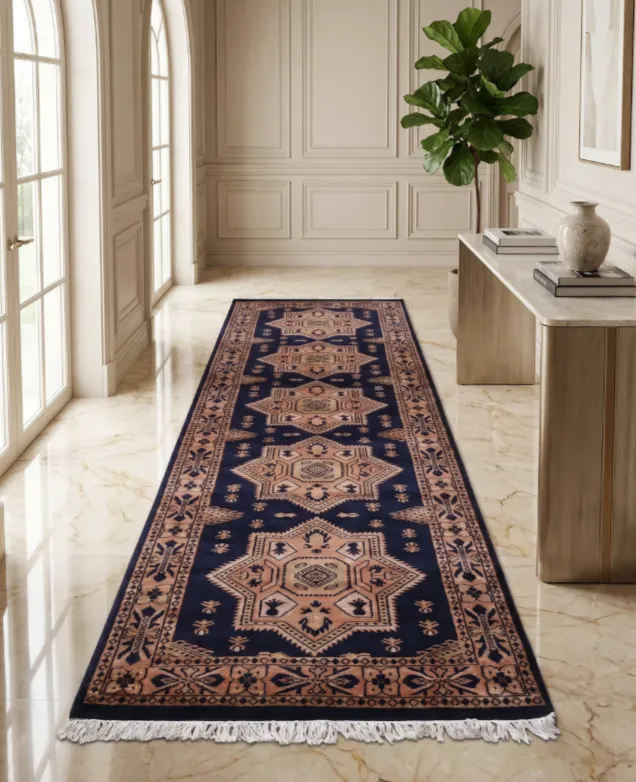
There’s a reason a handmade carpet feels different underfoot than a machine-made one, and it’s not just texture. Somewhere in that weave is a language. It has been used for centuries to convey protection, fertility, status, and even the afterlife, without a single word. Most of us walk over these symbols every day without knowing it. We just know the rug looks good with the sofa.
But the patterns in handknotted carpets were rarely just decoration. In most weaving cultures, a motif was chosen the way a sentence is chosen – to say something specific. Once you know how to read a few of them, rugs start looking completely different.
Persia: Where The Rugs And Carpets Were Maps Of Paradise
Start with Persian carpets, since most other traditions either borrowed from them or reacted against them. The central medallion on so many Persian and Indo-Persian rugs often represents a pool or the center of a garden, with the rest unfolding outward like a paradise garden.
Color carried weight, too. Blue carpets tend to stand for the divine and the infinite. Red carpets suggest joy, courage, or wealth. Even the borders weren’t filler. An unfinished or “open” border was sometimes read as a wish for prosperity to keep flowing rather than being boxed in.
Anatolia And The Caucasus: Carpets As Protection
As Turkish and Caucasian weaving traditions move into the foreground, the symbolism becomes more literal, almost talismanic. Hooked motifs and hand shapes were woven in to ward off the evil eye. Birds such as eagles, peacocks, and doves stand in for power, happiness, or love. Though not every bird was a good omen, owls and ravens carried the opposite meaning in several regional traditions.
In nomadic and village weaving especially, these motifs were closer to a visual insurance policy, woven into something a family would sit, sleep, and pray on every day.
Tibet, China, And The Idea Of The Eternal
Head east, and the meaning of carpets changes. It’s less about warding things off, more about what lasts. Tibetan and Buddhist weavers use the endless knot. It looks like a loop with no real start or finish to point at something bigger: the idea that life just keeps cycling, nothing fully ends.
The Chinese rugs tradition took a different route, with geometric patterns drawn from dynastic design woven in because they were thought to bring balance and luck to a space. That’s probably why you’d find them in temples and formal halls more than in an everyday sitting room.
Closer To Home: What Indian Rugs Were Really Saying
India’s own weaving traditions carry just as much meaning, even if they read as more understated to an outsider’s eye.
Take the dhurrie. The flat-woven cotton or wool rug has been a part of Indian homes for centuries. Its stripes and geometric patterns weren’t only practical; they were also easy to weave on a simple horizontal loom. Floral motifs run through dhurries and hand-knotted rugs alike. Lotuses, roses, and vines were tied to fertility, abundance, and life continuing to bloom within the household.
There’s also a quieter, social symbolism at play. In many parts of India, laying out a dhurrie or rug for a guest was, and still is, a gesture of hospitality. That’s a different emotional register from “rug as decor,” and it’s worth holding onto.
You can still trace Mughal influence in many Indian rugs today. Designs such as medallions, vine work, and formal symmetry are prevalent in pieces from Agra and parts of Rajasthan. It’s really the old Persian idea of a garden as paradise, just filtered through Indian hands and Indian color.
But it didn’t stay one thing. Bhadohi, Jaipur, and Panipat each took that root and grew its own version. Look at two handwoven carpets from different parts of the country, and you’ll see the resemblance, but they’re never quite the same.
Why does this still matter when you’re shopping for a rug?
None of this means memorizing a glossary of motifs before buying one. But it does change how you look at a rug. A handmade carpet isn’t just a floor covering chosen to match your cushions. It’s the end product of a tradition that used pattern and color to say things people didn’t always say out loud. Protection for the house. Welcome to the guests. A wish for things to keep flowing rather than run dry.
That’s also, in a roundabout way, why handmade rugs and carpets still beat machine-made, symbolism aside.
That’s really what you’re paying for when you pick handcrafted carpets. Not just something that fits the room, but a piece that someone actually sat and made, knot by knot, the way it’s been done for generations.
Kesari Home’s handmade carpets come from the same process: artisans working in wool, using techniques that go back long before any of us were buying rugs online. You’re not just decorating a floor. You’re keeping a small, very old craft going for one more rug.